

Why Your Gut Health Matters for Cancer Treatment and Vaccination Success
Your body is home to trillions of microbes—mostly bacteria—in your gut, known as the microbiome. These tiny helpers do more than aid digestion: they play a surprising role in how well cancer treatments and vaccines work. Here’s what scientists have discovered:
1. The Microbiome: Your Immune System’s Partner
The microbiome acts like a “training ground” for your immune system. It helps:
- Fight infections
- Reduce harmful inflammation
- Balance immune responses (to avoid overreacting or underreacting)
Recent research shows it also influences cutting-edge cancer therapies and vaccines.
2. Cancer Immunotherapy and Gut Bacteria
Immune checkpoint inhibitors (ICIs) are drugs that help the immune system attack cancer cells. They work by blocking “brakes” that cancer uses to hide. But not everyone responds well to ICIs—and gut bacteria might explain why.
Key Findings:
A. Helpful Bacteria Improve Treatment:
-
-
- Faecalibacterium prausnitzii (linked to healthy guts) and Bifidobacterium (found in yogurt) are tied to better outcomes.
- These bacteria boost immune cells that kill tumors.
-
B. Harmful Effects of Antibiotics:
-
-
- Antibiotics, which wipe out gut bacteria, can reduce ICI effectiveness.
- Patients on antibiotics before/during treatment often have worse outcomes.
-
C. Bacteria as Medicine:
-
-
- Transferring gut bacteria from “responders” (patients who improved) to mice helped shrink tumors.
- Specific bacteria, like Akkermansia muciniphila, activate immune cells to fight cancer.
-
3. Vaccines and the Microbiome
Vaccines teach your immune system to recognize threats. The microbiome affects how well this works:
A. Gut Bacteria Boost Vaccine Response:
-
-
- Some bacteria produce substances (like short-chain fatty acids) that strengthen immune memory.
- For example, Bacteroides fragilis improves antibody production.
-
B. Implications for Future Vaccines:
-
-
- Tailoring gut bacteria (via probiotics or diet) could make vaccines more effective, especially in older adults or those with weak immune systems.
-
4. What This Means for You
A. During Cancer Treatment:
-
-
- Avoid unnecessary antibiotics.
- Ask your doctor about probiotics or dietary changes to support gut health.
-
B. Before Vaccinations:
-
-
- A fiber-rich diet (which feeds good bacteria) might enhance protection.
-
C. Future Treatments:
-
-
- Scientists are exploring “microbiome therapies,” like fecal transplants or targeted probiotics, to improve cancer and vaccine outcomes.
-
Your gut bacteria are more than just digestive aids—they’re critical teammates in fighting disease. By nurturing your microbiome, you might unlock better results from modern medicines.
Source: Summarized from “Immunomodulation by the Commensal Microbiome During Immune-Targeted Interventions” (PMC8155485).
Key Terms:
-
-
- Immune Checkpoint Inhibitors (ICIs): Drugs that help the immune system attack cancer.
- Short-Chain Fatty Acids (SCFAs): Substances made by gut bacteria that support immunity.
- Probiotics: Live bacteria that benefit health (e.g., yogurt, supplements).
-
Immune Checkpoint Inhibitors (ICIs): Drugs that help the immune system attack cancer.
Immune checkpoint inhibitors (ICIs) are a type of immunotherapy drug that helps the body’s immune system recognize and attack cancer cells more effectively. Normally, immune cells called T cells have “checkpoint” proteins that act like brakes, preventing them from attacking healthy cells. Cancer cells can sometimes trick these checkpoints, making the immune system ignore them. ICIs block these checkpoints, allowing the immune system to see and destroy cancer cells. This approach has led to significant improvements in treating many types of cancer, such as melanoma, lung cancer, and kidney cancer.
Short-Chain Fatty Acids (SCFAs): Substances made by gut bacteria that support immunity.
Short-chain fatty acids (SCFAs) are small molecules produced when gut bacteria break down dietary fiber in the large intestine. SCFAs play an important role in supporting a healthy immune system by helping to regulate immune cell activity and reduce harmful inflammation. These substances act as signals between gut bacteria and immune cells, promoting a balanced immune response and helping the body defend against infections and diseases. Research suggests that SCFAs may also enhance the effectiveness of vaccines and cancer treatments by supporting immune memory and function.
Probiotics: Live bacteria that benefit health (e.g., yogurt, supplements).
Probiotics are live microorganisms, typically beneficial bacteria, that are consumed through foods like yogurt or as dietary supplements. When taken in adequate amounts, probiotics help maintain or restore the natural balance of gut bacteria, which is important for digestive health and overall well-being. In addition to supporting digestion, probiotics can boost the immune system, help prevent infections, and may even improve the body’s response to certain treatments by promoting a healthy gut microbiome.
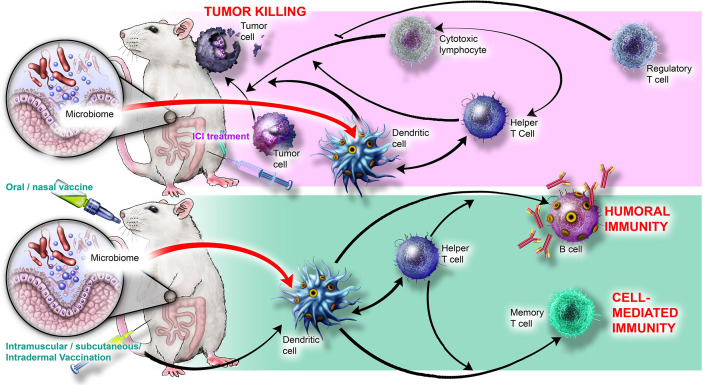
How the Immune System Fights Cancer and Responds to Vaccines
Immune Checkpoint Inhibitors (ICIs) and Gut Bacteria (top panel)
ICIs are treatments that help the body’s immune system attack cancer cells by boosting certain immune cells—like natural killer cells, helper T cells, and dendritic cells—that can kill tumors. However, some immune cells called regulatory T cells (Tregs) can get in the way and slow down this process.
Interestingly, certain helpful bacteria in our gut make substances that can encourage the immune system to fight cancer even better. These substances, called MAMPs, interact with sensors on immune cells, making them more active and helping the ICIs work more effectively. Other molecules made by gut bacteria, like inosine, can also help by making T cells multiply and become stronger against cancer.
How Vaccines Work (bottom panel)
Vaccines—whether they’re made from weakened germs, dead germs, or just parts of germs—teach the immune system how to recognize and fight off harmful invaders. They do this by activating helper T cells and dendritic cells, which then help B cells make protective antibodies and help create memory T cells for long-lasting protection. Some parts of germs, like flagellin and peptidoglycan, can further boost the vaccine’s effect by activating special sensors on immune cells. Additionally, substances made by gut bacteria, called short-chain fatty acids (SCFAs), can also help dendritic cells do their job better. Both cancer treatments (like ICIs) and vaccines rely on the immune system’s teamwork, and helpful gut bacteria can make these treatments even more effective by giving the immune system extra encouragement.
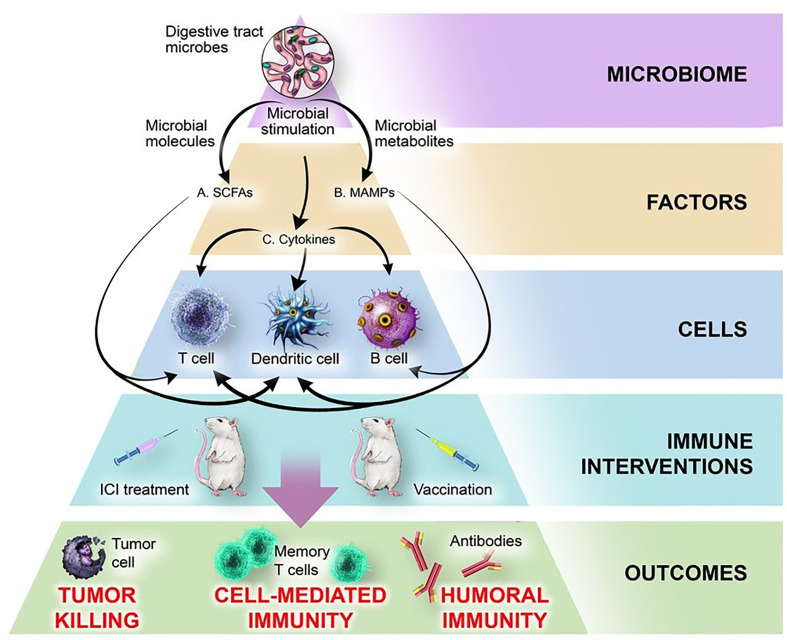
For more information and to see the published research, please visit,
Front Immunol. 2021 May 13;12:643255. doi: 10.3389/fimmu.2021.643255
Immunomodulation by the Commensal Microbiome During Immune-Targeted Interventions: Focus on Cancer Immune Checkpoint Inhibitor Therapy and Vaccination
Abigail L Reens 1, Damien J Cabral 1, Xue Liang 1, James E Norton Jr 1, Alex G Therien 1, Daria J Hazuda 1,2, Gokul Swaminathan 1,*
PMCID: PMC8155485 PMID: 34054810
https://pmc.ncbi.nlm.nih.gov/articles/PMC8155485/


